Don Quixote
An old knight in dented armour sees three white towers on the ridge that were not there before, puts a washbasin on his head because a helmet helps you think, and rides out.
Don Quixote and his servant Andres · 36 pages · 8 × 8 inches square hardcover
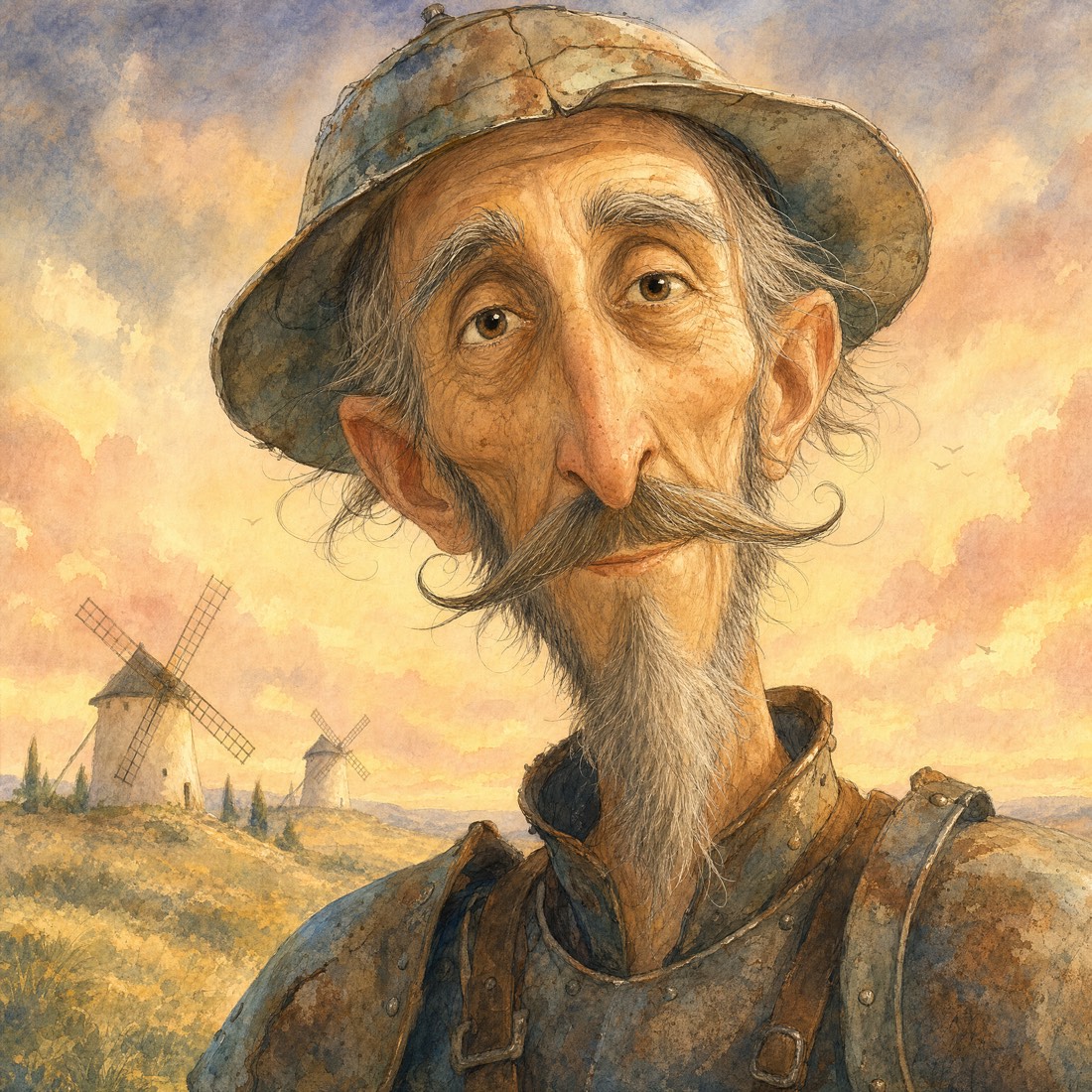
The cover, printed on the case
Every page
Two facing pages share one illustration, so a picture runs right across the opening.
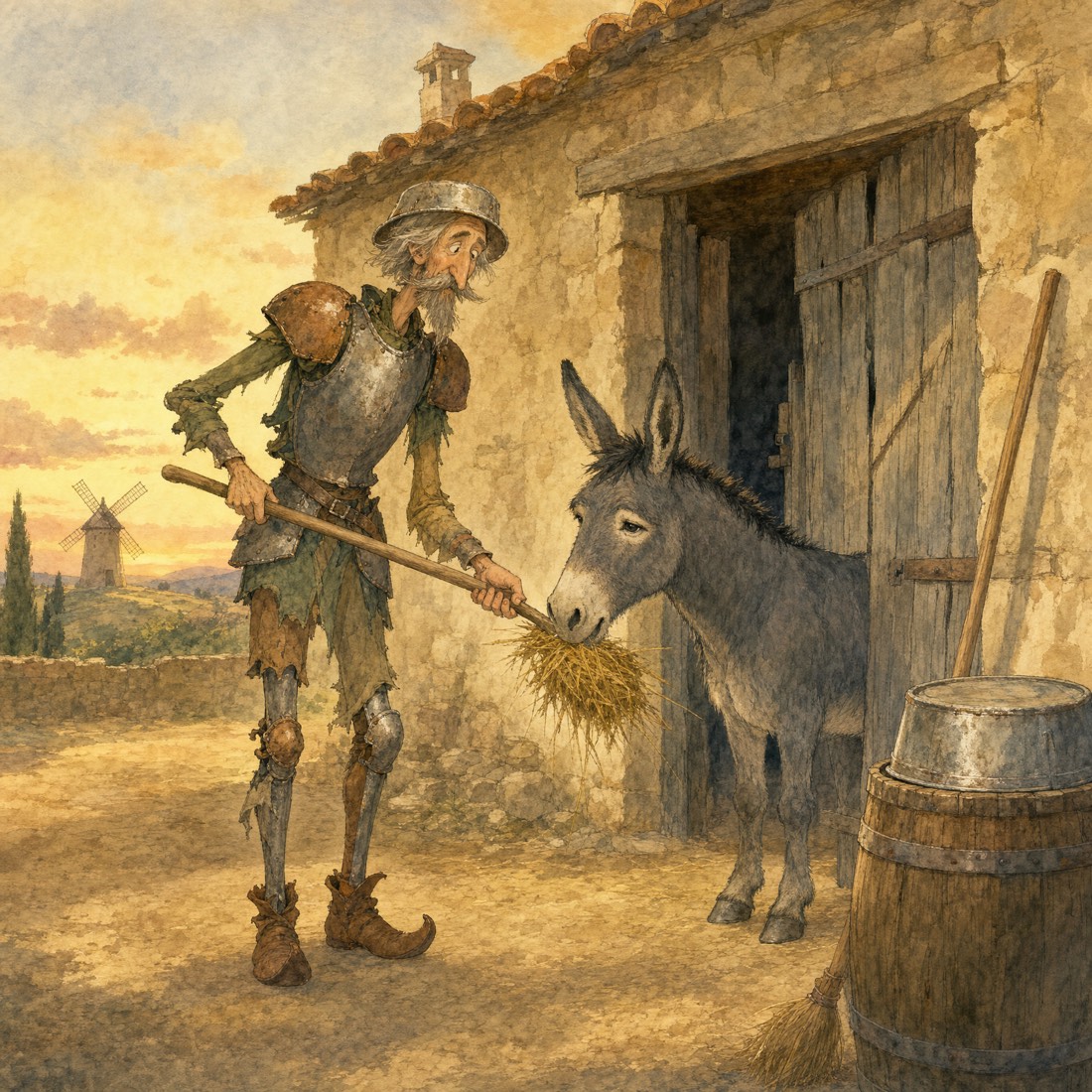
Every evening in La Mancha, when the sun went gold and slow, Don Quixote forked hay to the grey donkey. His old spear leaned against the barn doors, though anyone else would have called it a broom handle. The dented tin washbasin sat upside down on its barrel. Nothing needed doing but this.
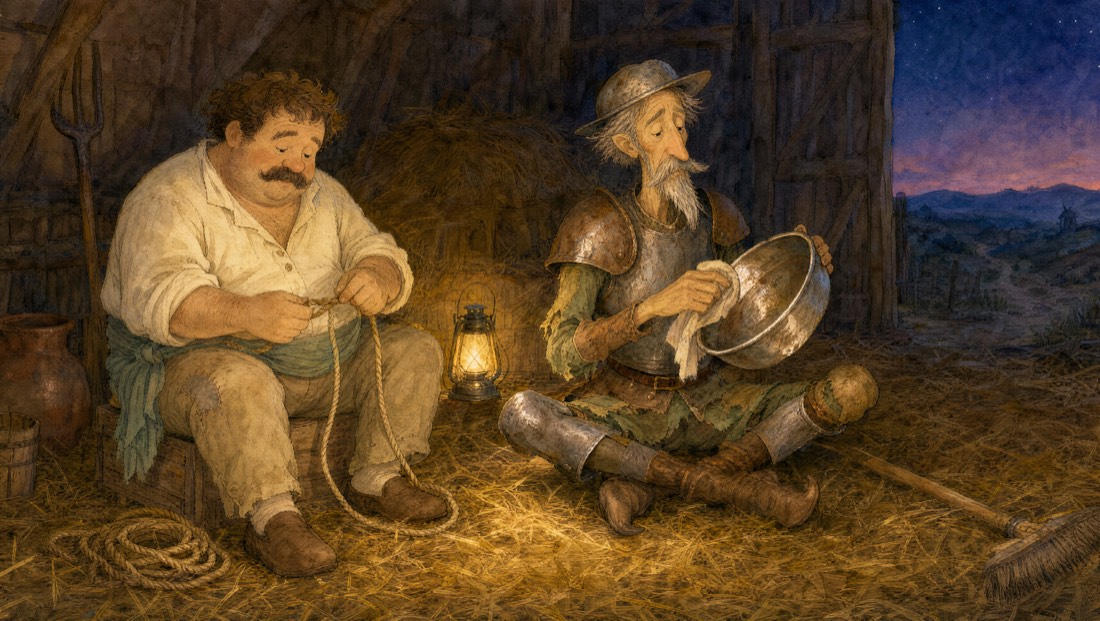
Inside, the lantern made a small warm room out of the dark. Andres sat on an upturned crate, splicing rope with his thick fingers, humming something with no tune in it.
Don Quixote rubbed the washbasin until it shone like a helmet. The spear lay in the straw beside him, waiting. It was a very good evening.
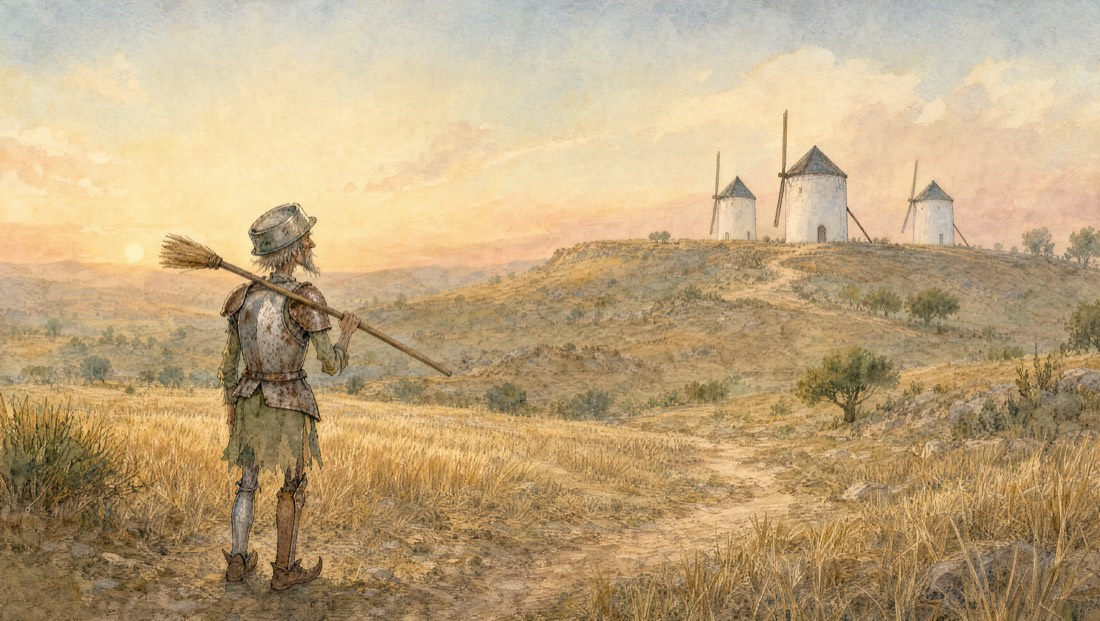
In the morning the field was cold and stubbly, and there were three white towers standing along the ridge that had not been there before.
Don Quixote stopped. He put the basin on his head, because a helmet helps you think. He counted them twice. Three. Still three.
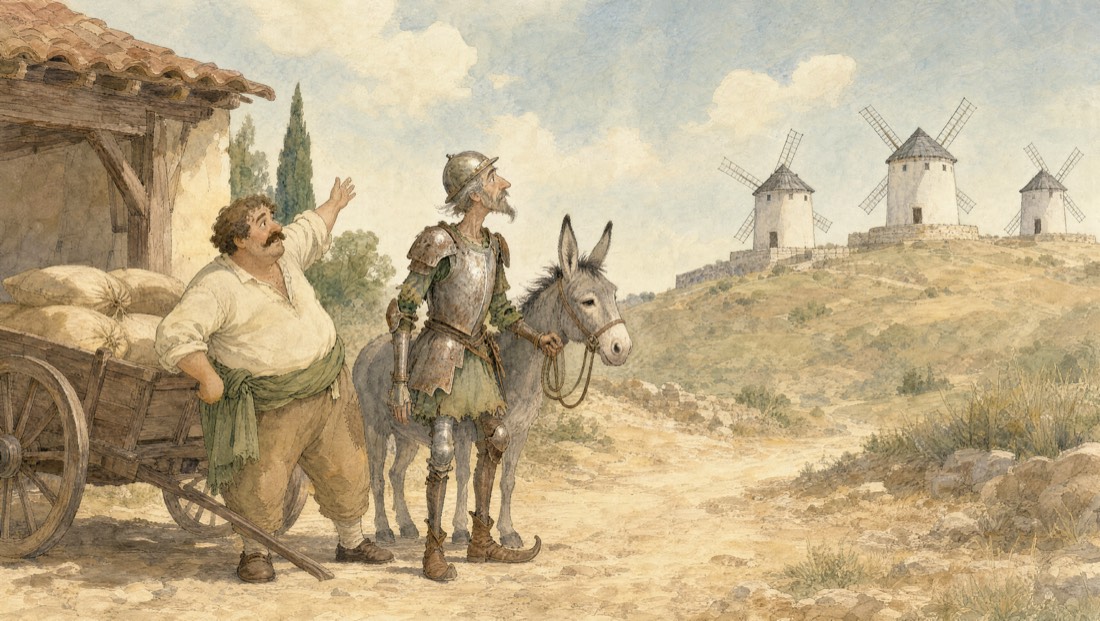
At midday Andres pointed up at the ridge and said a word: windmills. The miller would grind their grain up there now, he said, instead of the long dusty road to town.
He tapped the sacks on the cart. Don Quixote held the donkey's halter and did not stop staring.
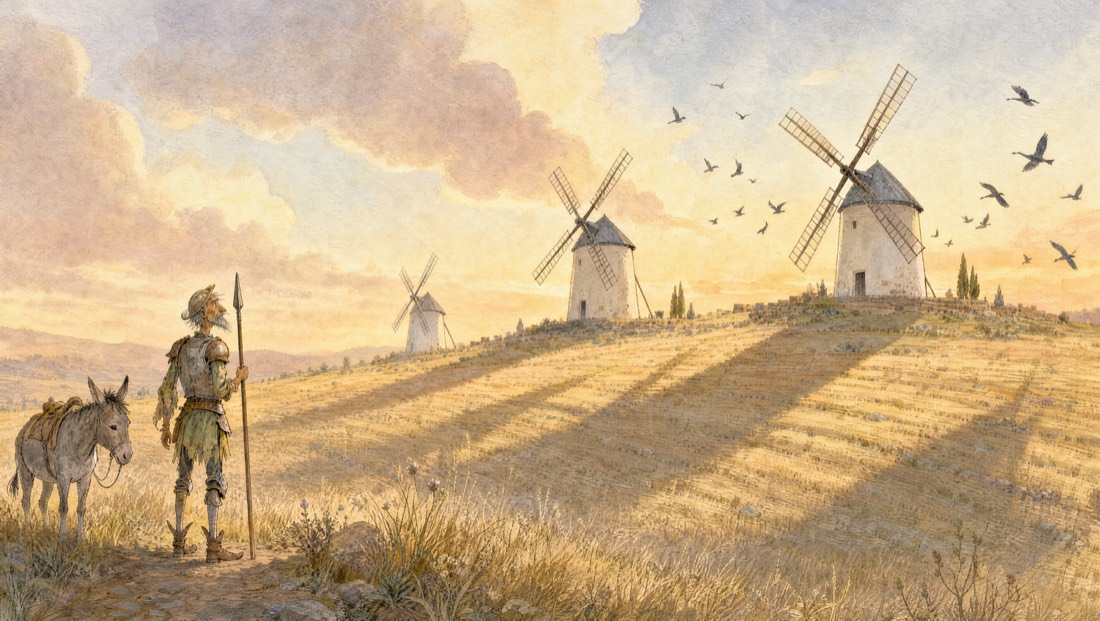
Then the sails began to turn. Long shadows swung across the stubble, one after another, like arms reaching. Every bird in the field went up at once.
From the far edge of a field, a boy and a donkey are very small things, and Don Quixote felt exactly that size.
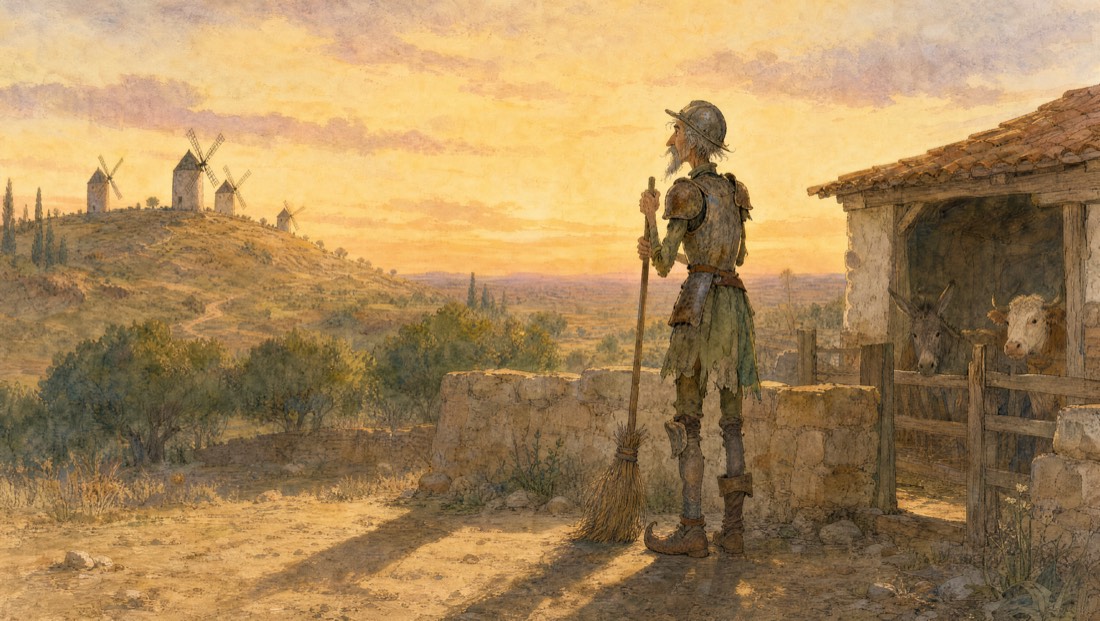
By late afternoon he had decided. Those were not towers. Towers do not wave. Giants wave, and giants come closer, and nobody else in the whole yard seemed the least bit worried about it. His hands tightened on the old spear. It is a lonely business, being the only one who notices.
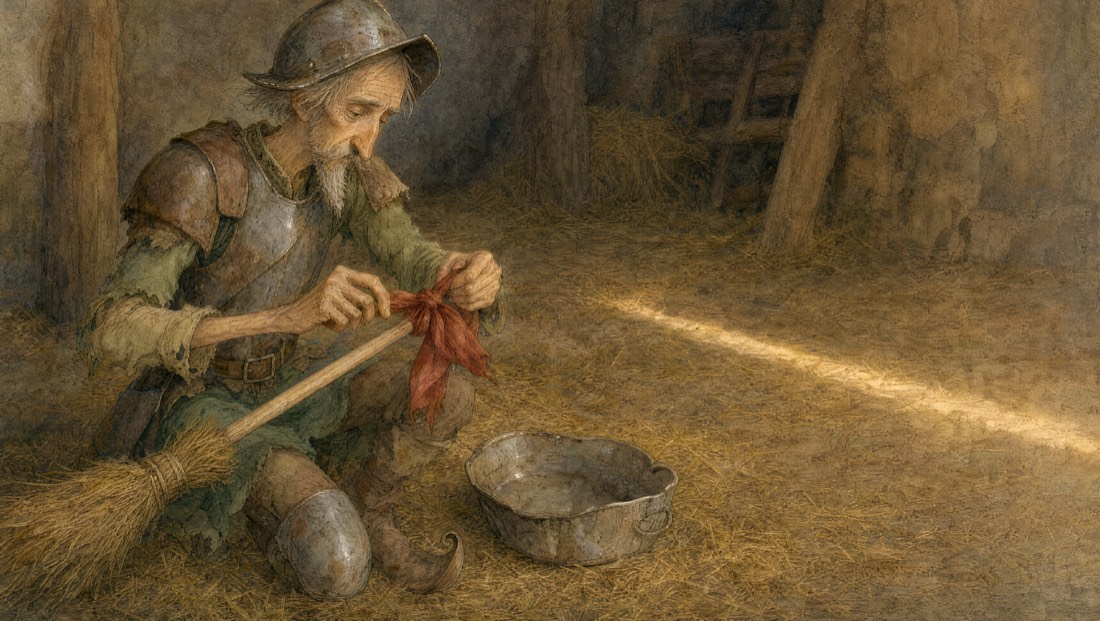
In the dim barn he tied his red kerchief to the end of the spear, knot over knot, pulled tight. Knights had a lady to be brave for.
He had the kerchief, which smelled of soap and of Andres. His fingers were not quite steady. He tied it again, to be sure.
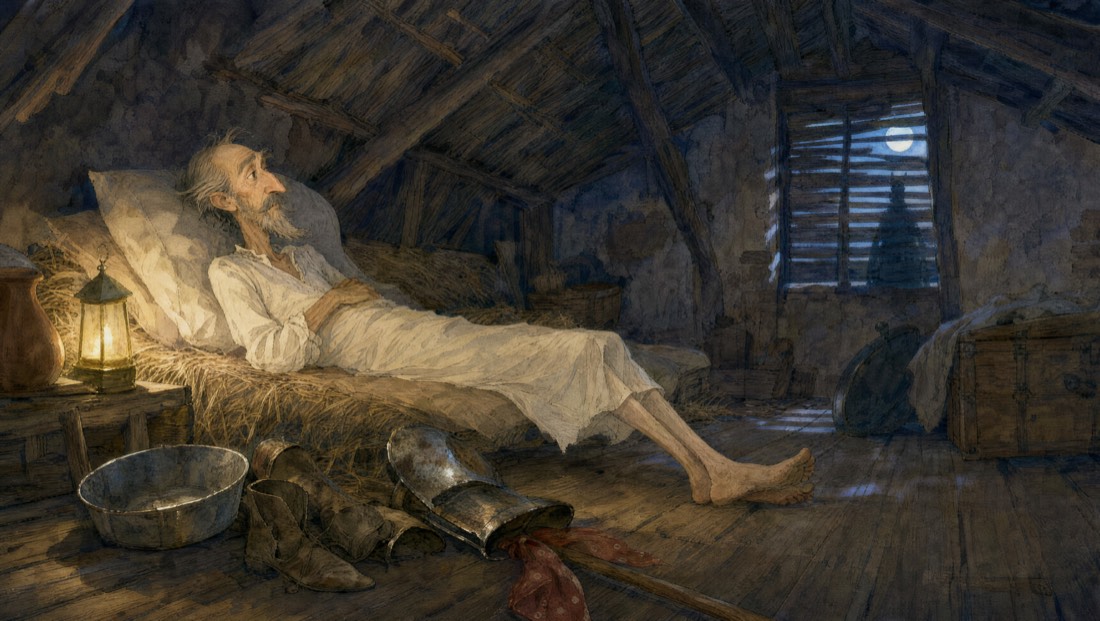
Up in the hayloft he lay flat and listened. Moonlight came through the shutter slats in stripes, and something slow slid across the stripes, and slid back again.
His boots waited. The basin waited. Don Quixote stared at the roof and did not name the feeling in his chest, but it stayed there all night.
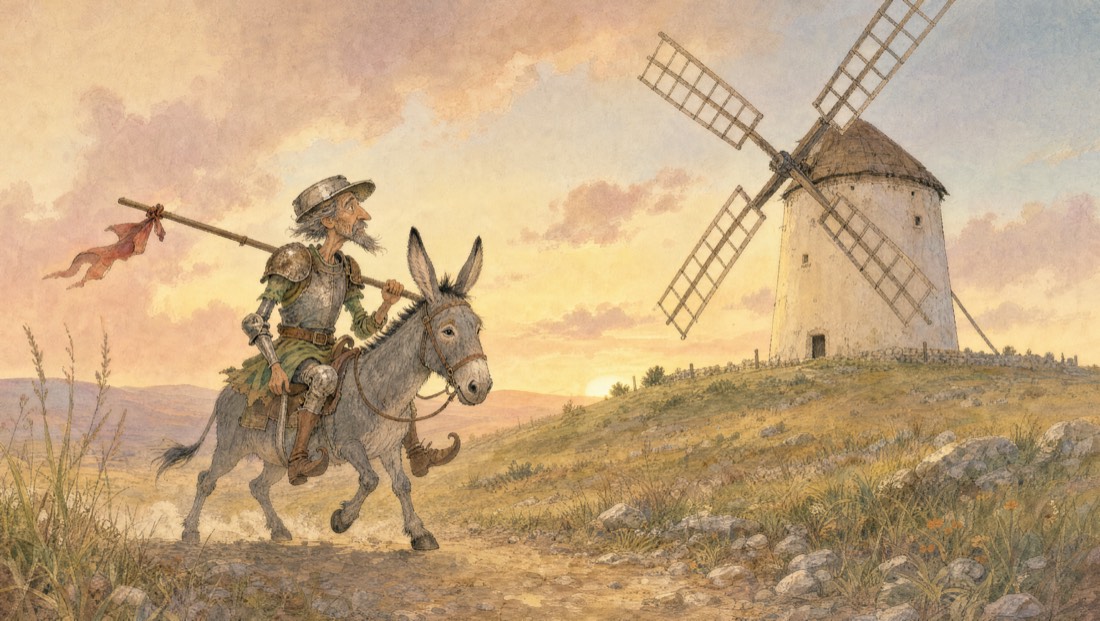
At first light he rode. The donkey trotted crookedly, the basin slipped down over one eyebrow, the red kerchief snapped and streamed behind him, and the nearest giant grew and grew until it filled the entire sky. Don Quixote levelled his old spear and shouted his very best shout.
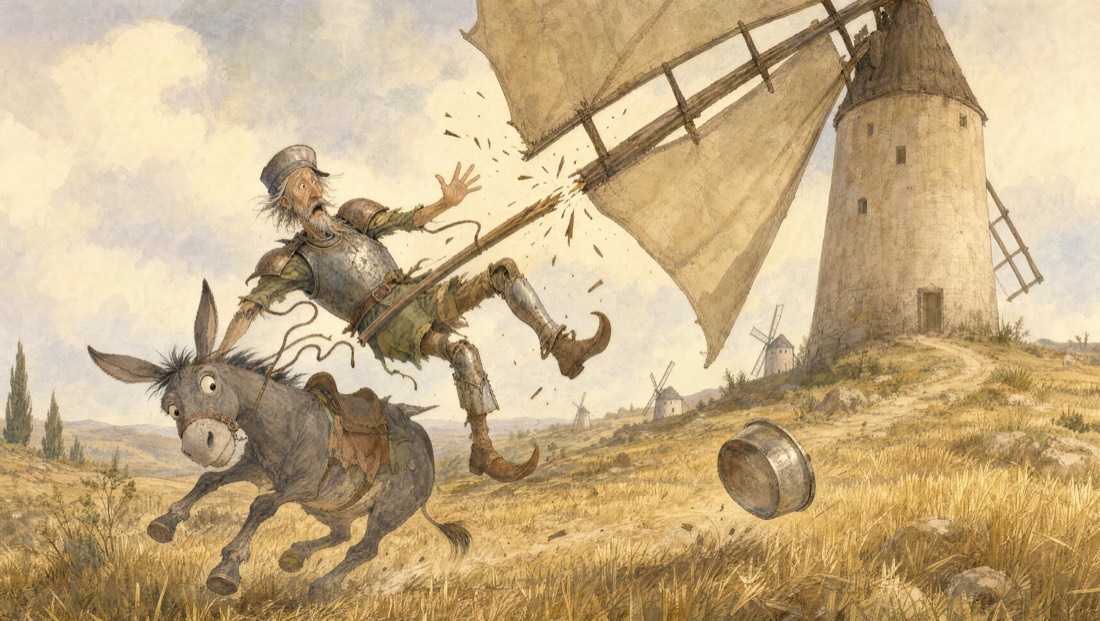
The sail came down like a door closing. It caught the spear, and there was a crack, and splinters flew up like startled sparrows.
Don Quixote left the saddle sideways. The donkey skittered off. The basin went bouncing away through the stubble, bong, bong, bong, and then everything was quiet.
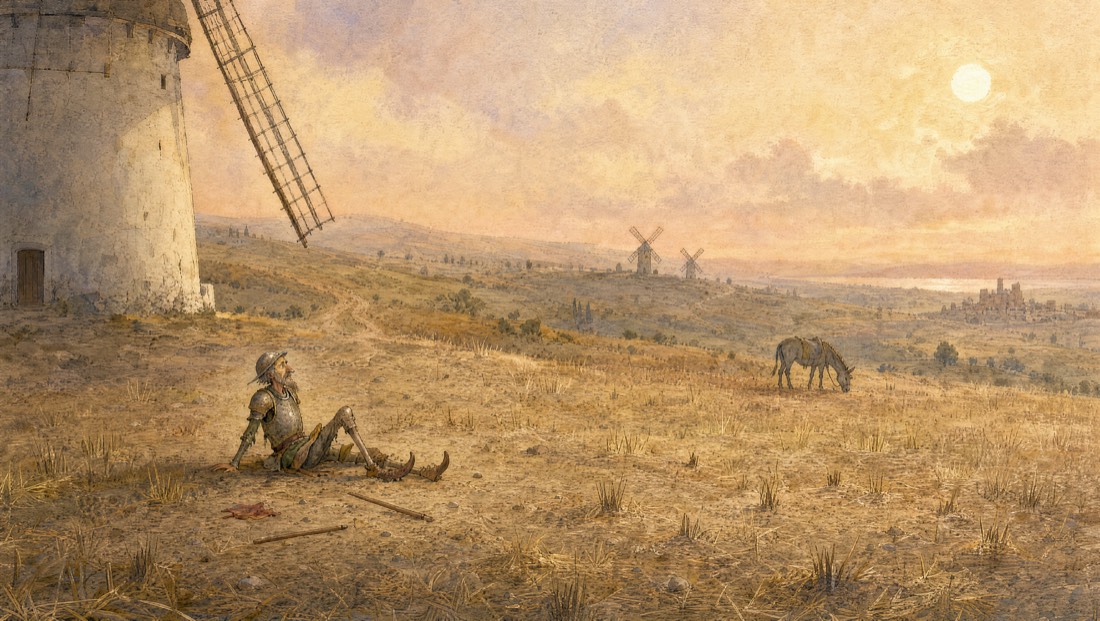
He sat in the dirt under the turning sails. His spear lay in two pieces. The kerchief was face down in the dust.
Above him the giant went on turning, patient, not even noticing him, which was somehow the worst part. Nothing hurt very much, except the part that wasn't his elbow.
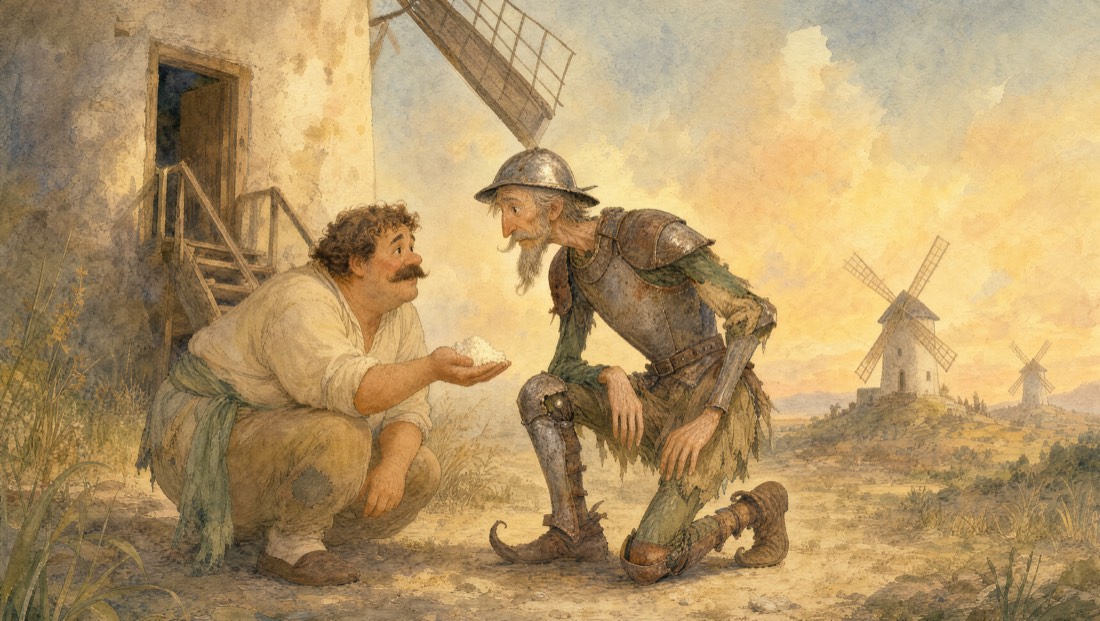
Boots came crunching over the stones. Andres crouched right down until his eyes were level with Don Quixote's, and held out one open hand.
In it lay a heap of pale flour, still warm from inside. "That is what it makes," he said. "All day long. Just this. " Behind him, the mill door stood open.
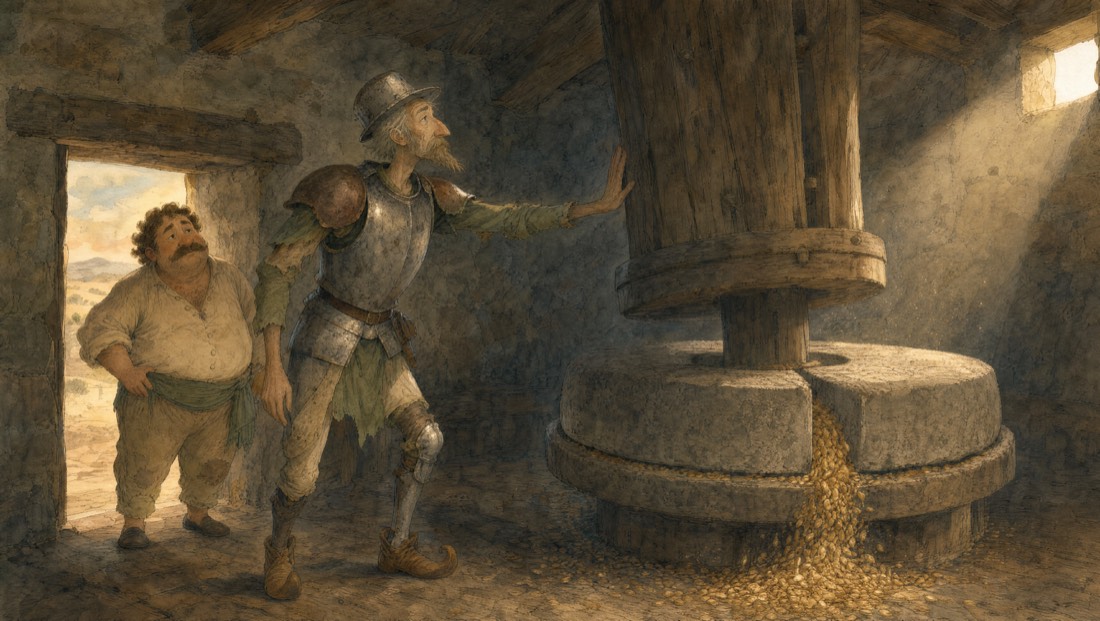
They went in. It was dim and floury, and it groaned like a big animal sleeping. Don Quixote laid his flat hand against the great wooden shaft and felt it turn, slow and steady, taking all the time it wanted. Grain whispered between the stones. Andres watched from the doorway and said nothing at all.
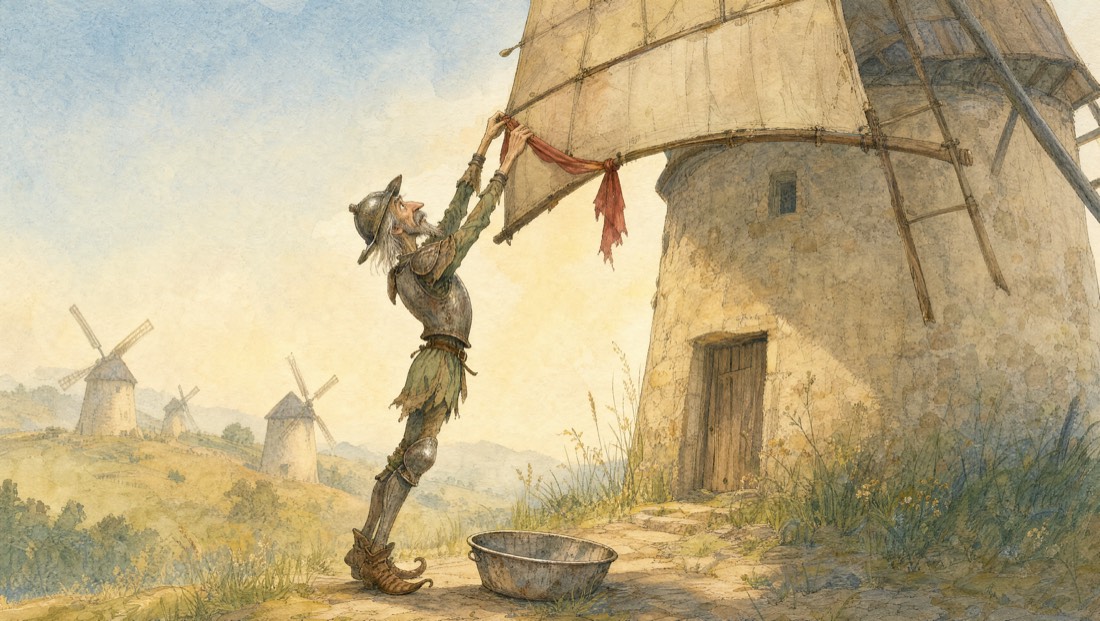
Next morning he came back with the kerchief washed. He waited in the mill yard, up on tiptoe, both arms stretched high, until the lowest sail swung down within reach.
Then he tied it on, quick — one knot, two — and stepped back, and let it go up without him.
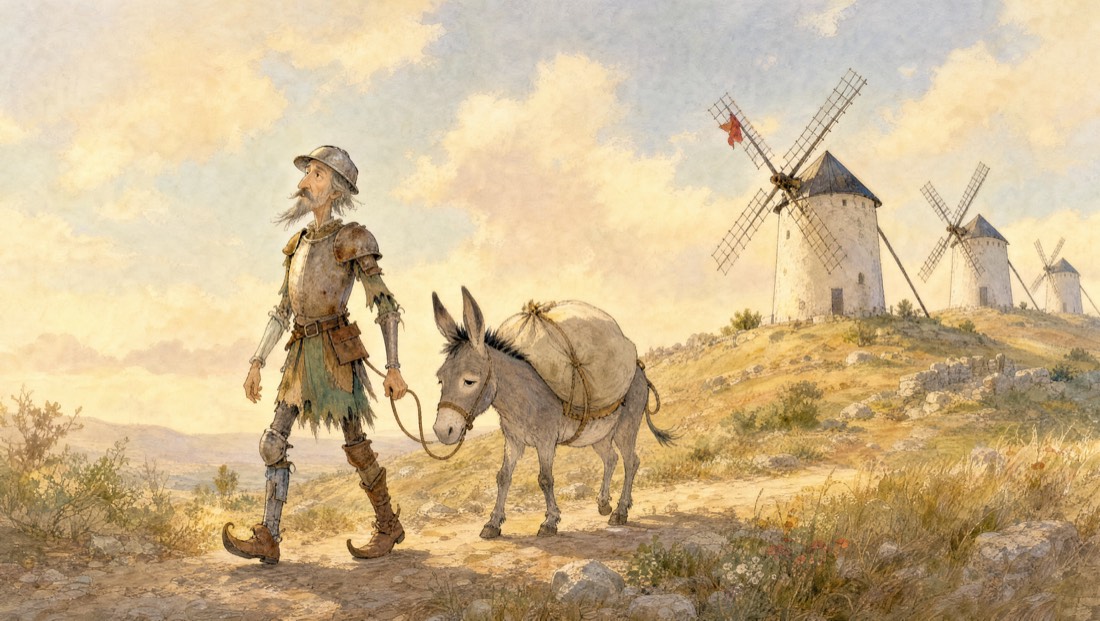
They walked home the short way, which was new too. The donkey carried a fat sack of flour, and Don Quixote carried nothing at all, which felt fine.
Behind them the three mills turned, and on one of them a small red flag went round and round and round.
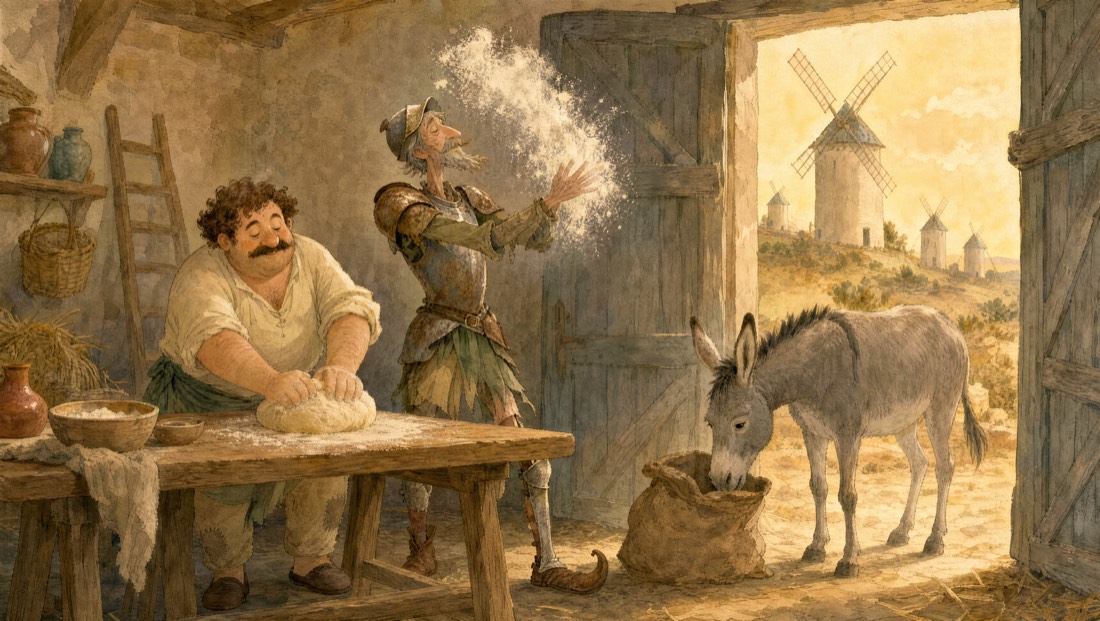
By afternoon the whole barn smelled of dough. Andres pushed and folded it on the plank table while Don Quixote clapped the flour off his hands in one great white cloud.
The donkey nosed the empty sack, hoping. Through the open grey doors, the sails kept turning, the way they do.
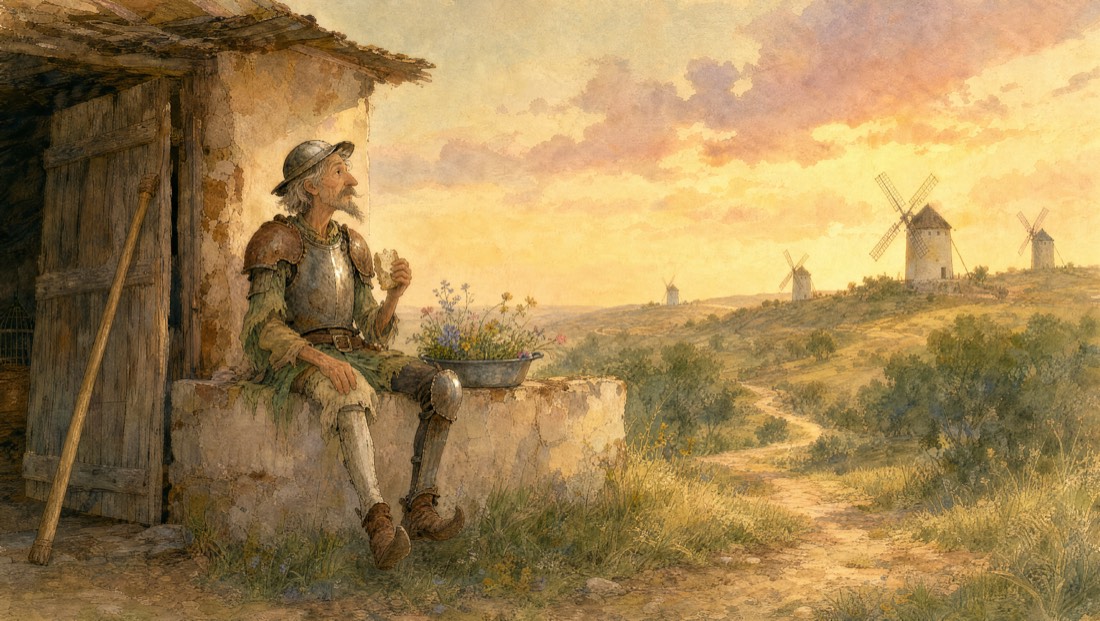
The bread came out with a crust that cracked. Don Quixote sat on the low yard wall with a torn warm piece, feet swinging, counting sails on the ridge: four, eight, twelve.
His mended spear held the barn door propped open. The old basin sat beside him, full of wildflowers.
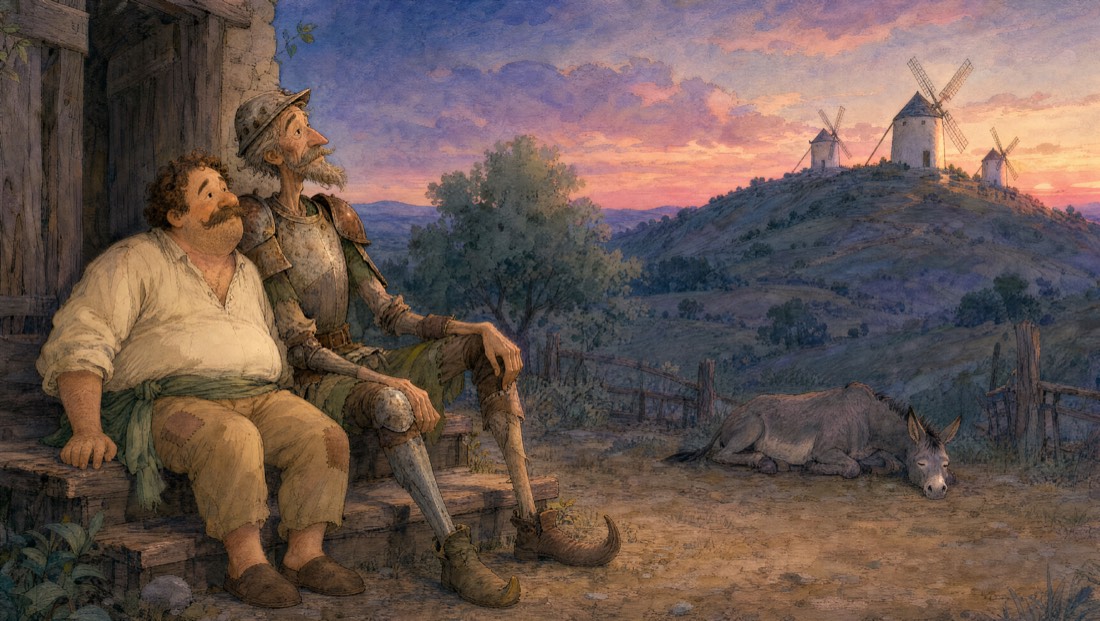
When the light went pink, the two of them sat on the barn step, Andres and Don Quixote, leaning together, saying nothing much.
The donkey dozed standing up in the yard. Far off, the sails caught the last of the sun and turned it slowly round, putting the day away.
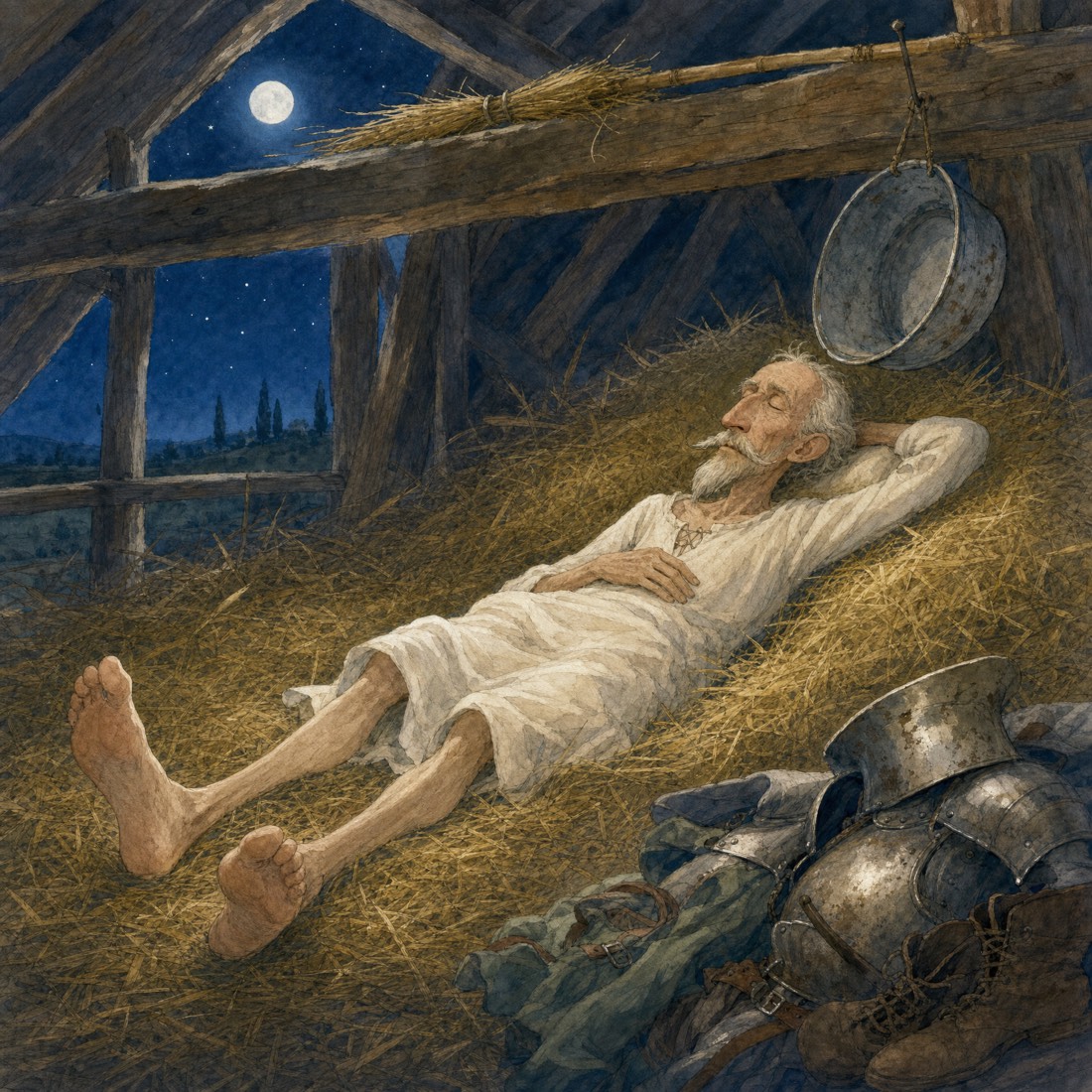
Up in the hayloft the straw is warm and the boots lie in a heap. The basin hangs on its nail. The mended spear rests across the beam, off duty until morning. Moonlight lies over everything, soft as flour, and a very brave knight sleeps right through the night.
Yours would be about someone you know
Same book, different people. Describe them and we'll write and draw it — free until you've read the whole thing.
Make a book